


When the Right Tool Is a Skilled Crew: Hand Demolition in a Machine Age
Demolition equipment keeps getting better. Excavators reach higher, attachments cut cleaner, and robotic demolition equipment does in hours what used to take a crew days. At ISI Demolition, we invest in all of it.
But some jobs still come down to people, hand tools, and a plan. A recent smokestack removal in Baltimore City is a good example.
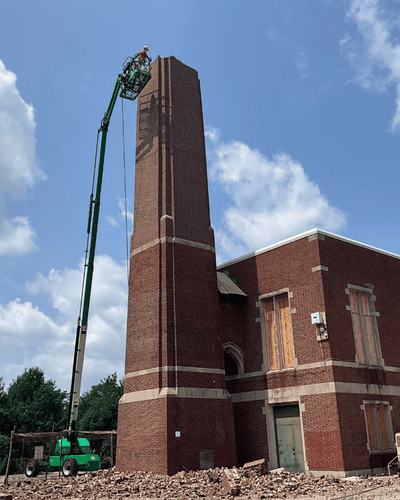
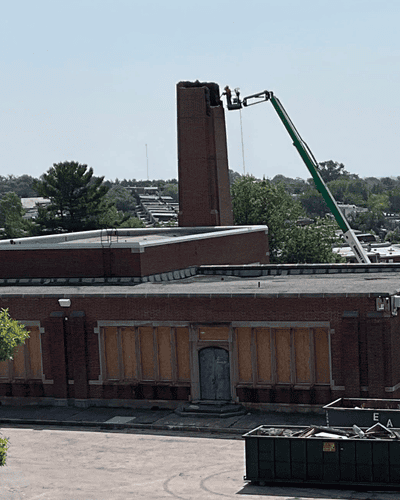
The job: taking down a smokestack, one course at a time
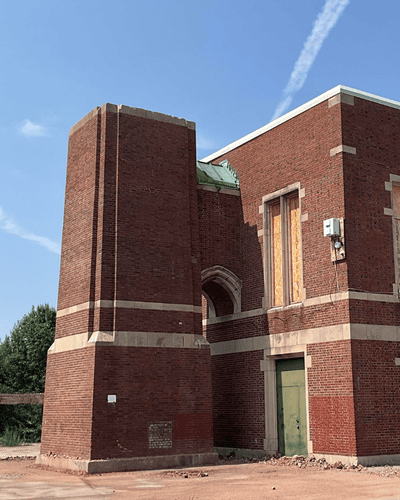
The brick smokestack stood tight against the building it served. Bringing it down meant working from the top, with the attached structure staying in place below.
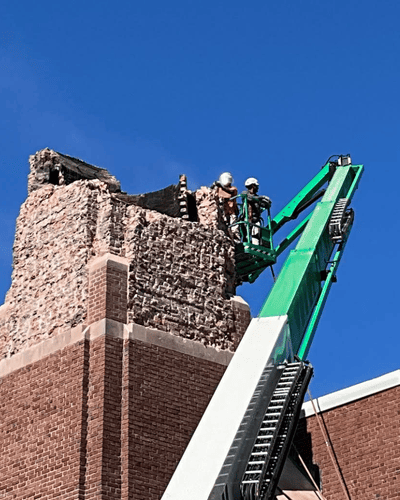
Our crew used a 120-foot boom lift to reach the top of the stack and took it apart by hand with rivet busters, working down in controlled lifts. Debris came down at the base in a managed zone, away from the building. The whole process took about three weeks and finished without issues.
No wrecking ball. No high-reach excavator. Just a trained crew, the right access equipment, and a sequence that kept everything around the stack protected.
Why not a machine?
It’s a fair question. Machines are faster on most jobs. Here’s why this one went to hand work:
- The building stayed. Pulling a stack over or knocking it down with a machine puts the attached structure at risk. Hand work lets the crew control exactly where every piece goes.
- Access. There’s no place to set equipment on top of a narrow masonry stack. A boom lift puts people where the work is.
- Control over speed. A high-reach machine can bring material down faster than you want it to. With hand tools, the crew removes only what they intend to remove.
- Site conditions. School campuses come with neighbors, nearby buildings, and tight laydown areas. A smaller footprint at ground level helps.
How ISI Demolition decides: hand, robotic, or machine
Every project starts with the same questions. The answers point to the method.
What stays, and how close is it?
When the work sits right next to a structure that has to survive, precision moves to the top of the list. That often means hand work or robotic demolition, depending on access.
Can equipment get to the work?
Robotic demolition equipment is powerful and runs 500 to 600 percent faster than handheld tools. It’s our first choice for a lot of interior and structural work. But it needs a surface to work from. When the work is 100 feet in the air on a stack, a lift and a crew are the answer.
What’s the material doing?
Old masonry, mixed construction, and unknown conditions call for a slower approach until you know what you’re dealing with. Our in-house structural engineers help figure that out before anyone starts swinging.
What does the schedule need?
Speed matters to every GC and owner we work with. But the fastest method on paper isn’t the fastest if it damages something that has to be repaired later. The right method is the one that finishes on time without creating new work.
Often the answer is a mix. A project might start with hand work to free up a section, switch to robotic demolition once there’s a working surface, and finish with heavy equipment for bulk removal.
Technology doesn’t replace skill. It extends it.
We use our Brokk robotic demolition equipment every chance we get. It keeps crews out of harm’s way and moves projects faster. But the people running it are the same people who know when to set it aside and pick up a rivet buster.
That judgment comes from experience. ISI Demolition has completed nearly 6,000 projects since 1990, and our crews are cross-trained across methods. They don’t default to one tool because it’s the one on the trailer.
Planning a project with tight constraints?
If you’ve got a structure that has to come down next to one that has to stay, talk to us early. We’ll help you work out the method before it becomes a schedule problem.